Bharatiya Janata Party
Historical background, organisational structure, BJP and RSS, ideologue and founder.
Bharatiya Janata Party
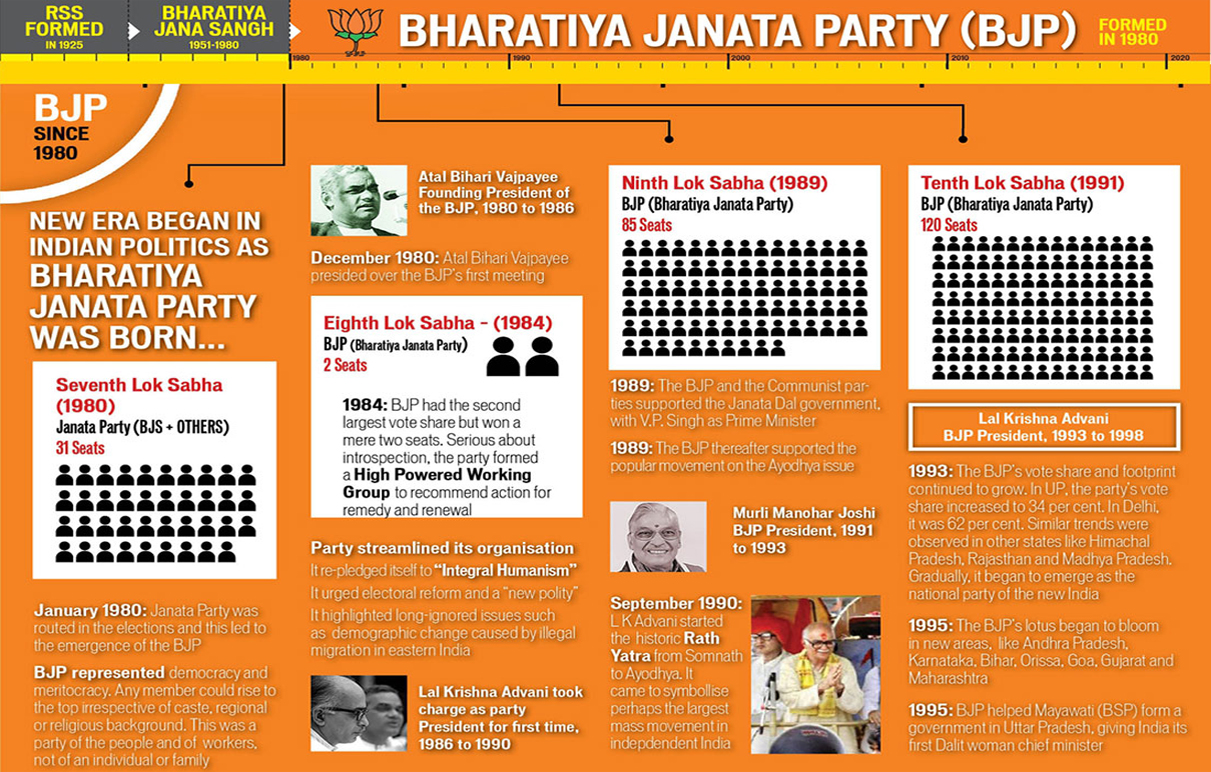
The Bharatiya Janata Party is one of the major political party in India. As of 2018, it is the country’s largest political party in terms of representation in the national parliament and state assemblies, and it is the world’s largest party in terms of primary membership.
BJP is a right-wing party, and its policy has historically reflected Hindu-nationalist positions. It has close ideological and organisational links to the Rashtriya Swayamsevak Sangh. In April 2015, the BJP stated that it had more than 100 million registered members, which would make it the world’s largest political party by primary membership.
The organisation of the BJP is strictly hierarchical, with the president being the highest authority in the party. Until 2012, the BJP constitution mandated that any qualified member could be national or state president for a single three-year term. This was amended to a maximum of two consecutive terms. Below the president is the national executive, which contains a variable number of senior leaders from across the country.
The Fountain Head: The BJP and the RSS
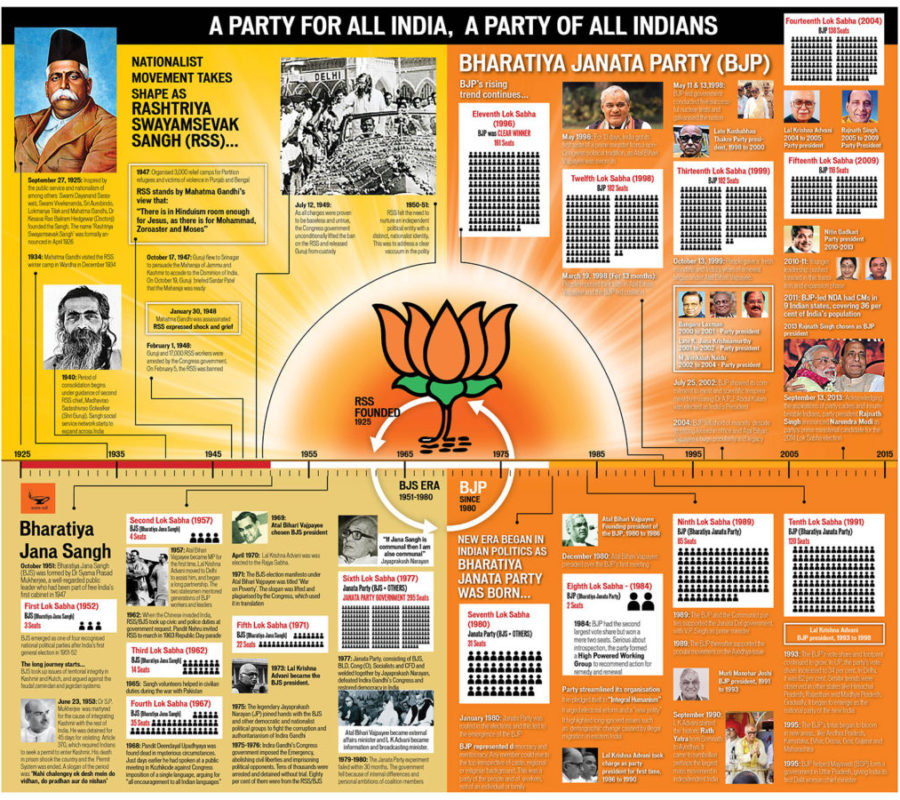
The Bharatiya Janata Party is today the most prominent member of the family of organisations known as the “Sangh Parivar” and nurtured by the Rashtria Swyamsevak Sangh (RSS). Like the RSS, the BJP is wedded to India’s unity and integrity, its intrinsic identity and the social strength, individual character and cultural uniqueness that have been the hallmark of this great country and its people for millennia.
History is the philosophy of nations. And the Sangh Parivar has a very clear and clear conception of Indian history. Here was a great civilization whose influence and imprint spread from Sri Lanka to Tibet, from Southeast Asia to Central Asia, from one end of the Indian Ocean to the other. It weathered the storms of invaders, from the Greeks to the Huns, the Shakas to the Islamic armies of Turks and Afghans. It fought and resisted external oppression and its essential civilization and culture survived great challenges and attempts at effacement.
In more recent times this torch of nationalism and Indian identity was carried forward by Swami Dayanand and Swami Vivekanada. In the present century the good work has been carried on by Sri Aurobindo, Lokmanya Tilak, Mahatma Gandhi and others. The RSS, founded by Dr K.B. Hedgewar in 1925 and consolidated by Shri Guruji M.S. Golwalkar after 1940, sees itself as the legatee of this heroic tradition.
It believes in the principle of: “Justice for all and appeasement of none”. It has no doubt about Hindu identity and culture being the mainstay of the Indian nation and of Indian society. This identity and this culture informs all Indians, irrespective of religious or denominational faith. To the RSS, all Indians, irrespective of religious background, notwithstanding their mode and place of worship, are equal.
Ideologue and Teacher
Pandit Deendayal Upadhyaya
1916–1968
Pandit Deendayal Upadhyaya (1916-1968)
Pandit Deendayal Upadhyaya was the leader of the Bharatiya Jana Sangh from 1953 to 1968. A profound philosopher, committed organization man and a leader who maintained the highest standards of personal integrity and dignity in public life, he has remained a source of ideological guidance and moral inspiration for the BJP since its inception.
His treatise Integral Humanism is a critique of both communism and capitalism. It provides a holistic alternative perspective for political action and statecraft consistent with the needs of the human race and the sustainability of our natural habitat.
A Short Biography
Pandit Deendayal Upadhyaya was born on September 25, 1916, in the sacred region of Brij – in the village of Nagla Chandraban in Mathura, in what is now Uttar Pradesh. He later went to high school in Sikar, where he excelled. The then Maharaja of Sikar awarded Pandit Upadhyaya a gold medal, Rs. 250 for books and a monthly scholarship of Rs.10.
Deendayalji passed his Intermediate exams with distinction in Pilani and left for Kanpur to pursue his B.A. and joined the Sanatan Dharma College. At the instance of his friend, Shri Balwant Mahashabde, he joined the RSS in 1937. In the same year, he received his B.A. in the first division.
After completion of his B.T., he worked full-time for the RSS and moved to Lakhimpur district in UP as an organiser. In 1955, he became the provincial organiser of the RSS in UP.
Deendayalji established the publishing house Rashtra Dharma Prakashan in Lucknow and launched the monthly magazine ‘Rashtra Dharma’. Later he launched the weekly ‘Panchjanya’ and still later the daily ‘Swadesh’.
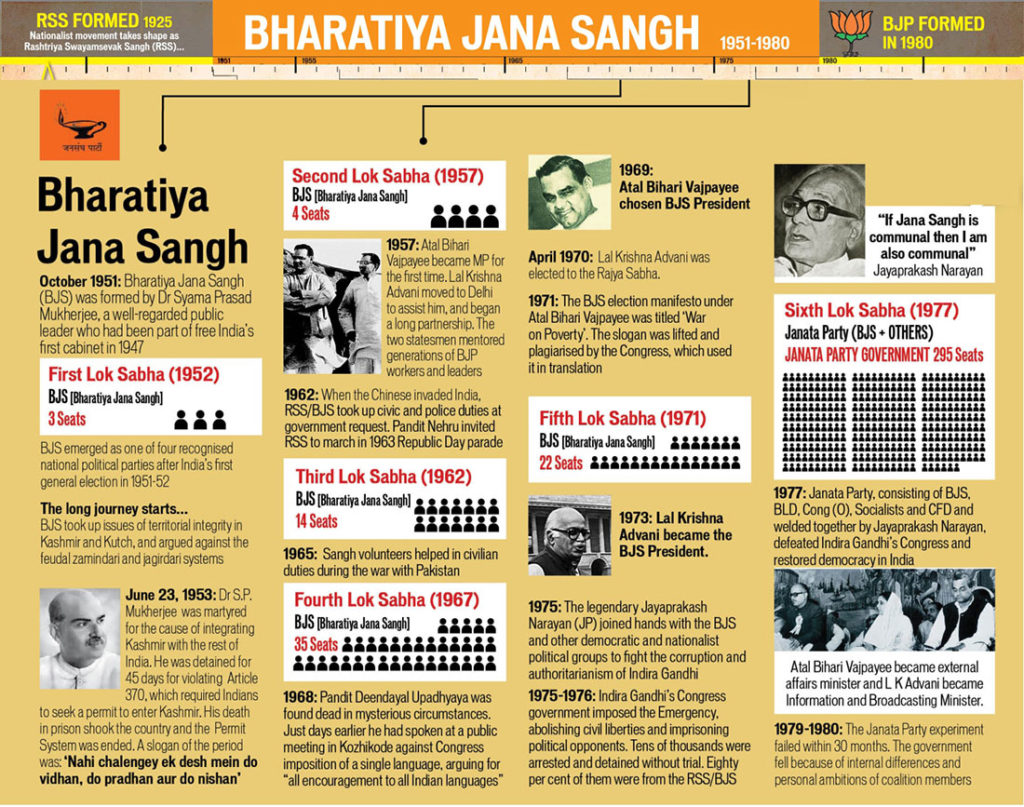
On September 21, 1951, he was instrumental in hosting a political convention in UP and founding the state unit of the new party, the Bharatiya Jana Sangh. Dr. Mookerjee presided over the first all-India convention a month later, on October 21, 1951.
On February 11, 1968, Pandit Deendayal Upadhyaya died at Mughalsarai railway station, according to the supplied source material.
Syama Prasad Mookerjee
Syama Prasad Mookerjee (1901-1953): Founder of the Bharatiya Jana Sangh
The BJP is the successor party of the BJS, which merged itself into the Janata Party in 1977. The BJP was formed as a separate party in 1980 after internal differences in the Janata Party resulted in the collapse of the Janata government in 1979.
A brief life-sketch
This brave son of India was born on July 6, 1901, to an illustrious family. His father Sir Asutosh was widely known in Bengal as an educationist and public intellectual. Graduating from Calcutta University, Dr. Mookerjee became a fellow of the Senate in 1923. He enrolled as an advocate in Calcutta High Court in 1924 and was called to the bar from Lincoln’s Inn in 1927.
At the age of 33, he became the world’s youngest Vice-Chancellor at the Calcutta University and held the office till 1938. During his tenure, he introduced a number of constructive reforms and was active in the Asiatic Society as well as being a member of the Court and the Council of the Indian Institute of Science, Bangalore.
Pandit Nehru inducted him in the Interim Government as Minister for Industry and Supply. Following the Delhi Pact between Nehru and Liaquat Ali Khan, Dr. Mookerjee resigned from the Cabinet on April 6, 1950. After consultation with Shri Golwalkar Guruji of the RSS, Dr. Mookerjee founded the Bharatiya Jana Sangh on October 21, 1951, in Delhi and became its first President.
In the 1951-52 election, the Bharatiya Jana Sangh won 3 seats in Parliament, one of them being that of Dr. Mookerjee. He then formed the National Democratic Party within the Parliament as a coalition of Lok Sabha and Rajya Sabha members.
Dr. Mookerjee was vociferous in the cause of the integration of Jammu and Kashmir with the rest of India. The supplied source states that he went to visit Kashmir in 1953 and was arrested on May 11, 1953, while crossing into the state and breaching the Permit System. He died while under arrest on June 23, 1953.