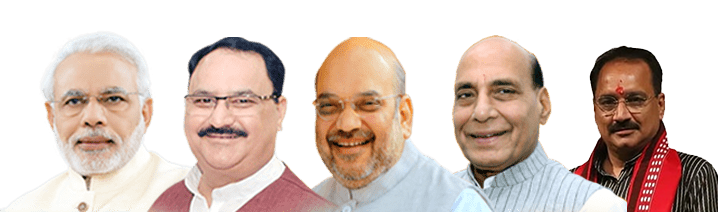
Shri Rajnath Singh Ji
Profile, Early Life and Political Career
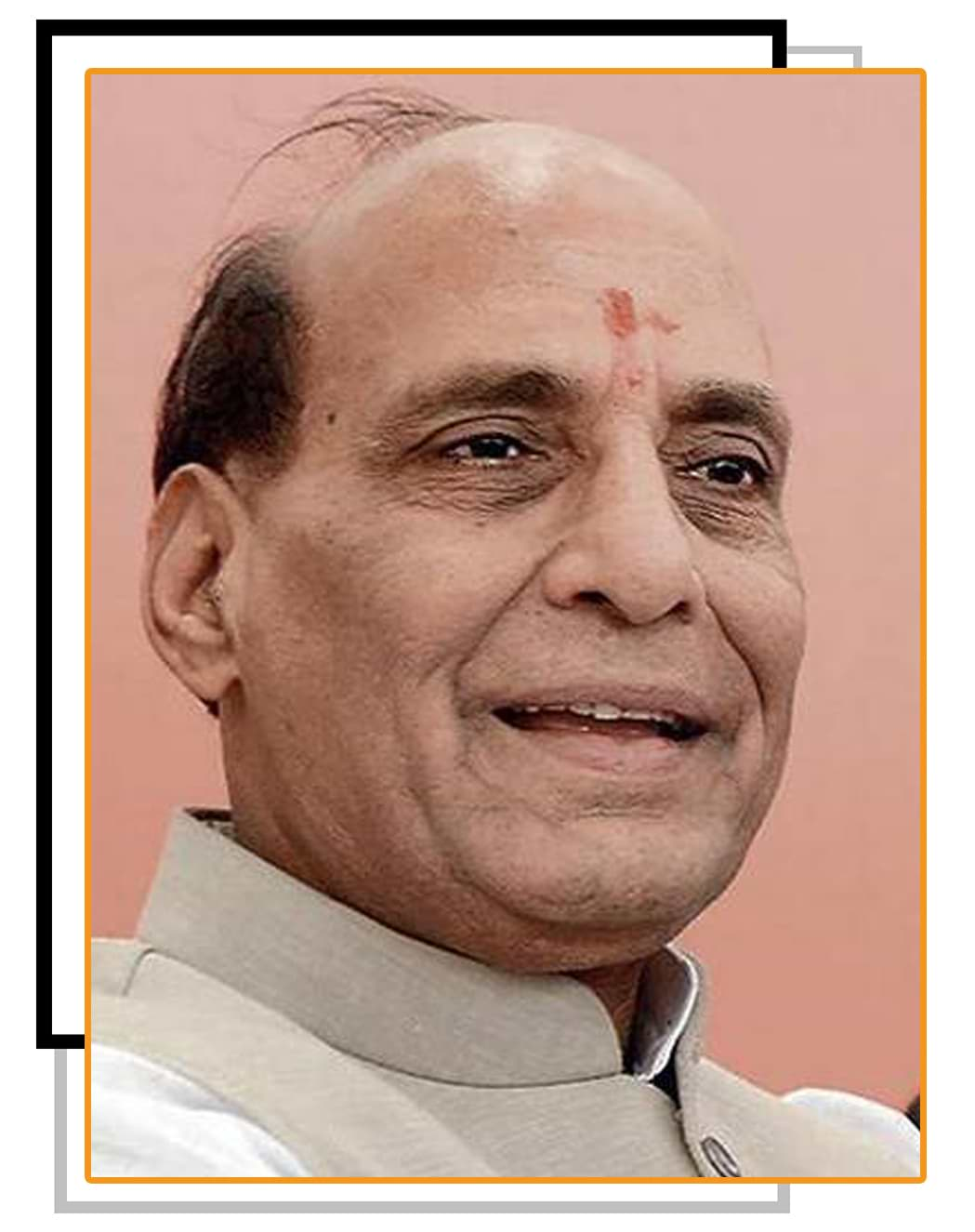
Rajnath Singh
Rajnath Singh (born 10 July 1951) is an Indian politician serving as the Defence Minister of India. He is the former President of Bharatiya Janata Party. He has previously served as the Chief Minister of Uttar Pradesh and as a Cabinet Minister in the Vajpayee Government. He was the Home Minister in the First Modi Ministry. He has also served as the President of the BJP twice i.e 2005 to 2009 and 2013 to 2014. He is a veteran leader of the BJP who started his career as a RSS Swayamsevak.
He has been Member of parliament, Lok Sabha two times from Lucknow (Lok Sabha constituency) and once from Ghaziabad (Lok Sabha constituency). He was also active in State Politics and remained MLA from Haidergarh (assembly constituency) twice being Chief minister.
Early Life
Rajnath Singh was born in Bhabhaura village of Chandauli district, Uttar Pradesh to father Ram Badan Singh and mother Gujarati Devi. He was born into a family of farmers. He received his primary Education from a local School of his village and went on to secure a master’s degree in physics, acquiring first division results from the Gorakhpur University. From childhood he was inspired by the ideology of Rashtriya Swayamsevak Sangh. He worked as a lecturer of Physics at K.B. Post-Graduate College Mirzapur, UP. He has also one brother, Jaipal Singh.
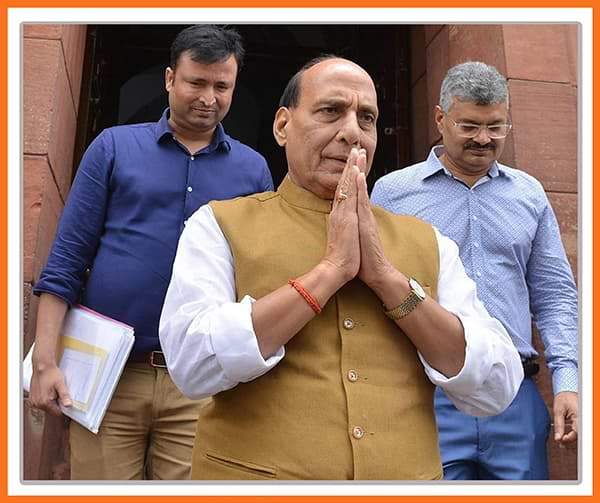
Political Career
Early career in RSS
He had been associated with the Rashtriya Swayamsevak Sangh since 1964, at the age of 13 and remained connected with the organisation. He also became Shakha Karavah (General Secretary) of Mirzapur in the year 1972. After 2 years in the year 1974, he joined the politics. Between 1969 and 1971 he was the organizational secretary of the Akhil Bharatiya Vidyarthi Parishad (the student wing of the RSS) in Gorakhpur. He became the general secretary of the RSS’s Mirzapur branch in 1972.
Entry into politics
In 1974, he was appointed secretary for the Mirzapur unit of the Bharatiya Jana Sangh, predecessor of Bharatiya Janata Party.
In 1975, aged 24, Singh was appointed District President of the Jana Sangh. In 1977, he was elected Member of Legislative Assembly from the Mirzapur. At that time he was influenced by the JP Movement of Jayaprakash Narayan and joined the Janata Party and was elected as Member of Legislative Assembly from Mirzapur. He was also arrested in the year 1975 during the state of National Emergency for associating with JP Movement and was detained for a time period of 2 years and when he was released, he was re-elected as Member Of Legislative Assembly.
At that time he gained popularity in State politics and joined BJP in the year 1980 and was one of the initial members of the Party. He became the State President of the BJP youth wing in 1984, the National general secretary in 1986 and the National President in 1988. He was also elected into the Uttar Pradesh legislative council.
Education Minister & Uttar Pradesh
Education Minister (1991-1992)
In 1991, when Bharatiya Janata Party made its government first time in Uttar Pradesh, he was appointed as the Education Minister. He remained minister for a tenure of two years. Major highlights of his tenure as Education Minister included Anti-Copying Act, 1992, which made copying a non-bailable offence, modernising science texts and incorporating vedic mathematics into the syllabus.
Anti-Copying Act, 1992
Singh helped push the controversial Anti-Copying Act in response to perceived wide-spread cheating in schools and colleges in Uttar Pradesh. After the fall of Kalyan Singh government in the year 1992, when Mulayam Singh Yadav became the Chief Minister of Uttar Pradesh, heading Bahujan Samaj Party in the year 1993 he repealed the Act.
Modernising of science texts and Vedic Mathematics
In 1991, he rewrote history texts and incorporated Vedic Mathematics into the syllabus. He also focused to revive modern tongue language instead of foreign languages, but also states and appreciates knowledge of modern languages.
Union Surface Transport Minister (1999-2000)
In April 1994, he was elected into the Rajya Sabha (Upper House of the Parliament) and he became involved with the Advisory committee on Industry (1994–96), Consultative Committee for the Ministry of Agriculture, Business Advisory Committee, House Committee and the Committee on Human Resource Development. On 25 March 1997, he became the President of the BJP’s unit in Uttar Pradesh and in 1999 he became the Union Cabinet Minister for Surface Transport.
Chief Minister of Uttar Pradesh (2000-02)
In 2000, he became Chief Minister of Uttar Pradesh and was twice elected as MLA from Haidergarh in 2001 and 2002. He was preceded by Ram Prakash Gupta as the Chief Minister and succeeded the President rule, later after Mayawati became the Chief Minister of Uttar Pradesh. At that time he was appointed as the Chief minister because from very long time he had made an image among people due to his ground level effect from long back the times of 1970’s in the JP Movement and was also the Education Minister in Kalyan Singh ministry and was also active in the State Politics.
Notable reforms as chief minister
While being the Chief Minister of Uttar Pradesh, had accused Samajwadi Party of providing jobs to a certain community only. Singh had said that discrimination in job opportunities should end in the state. He tried to rationalise the reservation structure in government jobs by introducing the most Backward Classes among the OBC and SC, so that the benefit of reservation can reach the lowest status of Society.
After being the Chief Minister of Uttar Pradesh in the year 2000, the first thing on which Singh focused was the Law and Order in the State. At that time Uttar Pradesh was at the top of the list of States of India in Crime and the Law and Order lacked a lot in the State. Whether he had done good work for the Law Reforms, but it was not applicable on Ground levels and after 2002 Gujarat riots a large portion of Public loose faith on BJP.
On 7 February 2001, Singh inaugurated the DND Flyway which connects Delhi to Noida.
Resignation
In the year 2002, he resigned from the position of Chief Minister of U.P. within the time of 2 years because at that time during the ground test, the BJP Government was at minority status. Because of the following reason there was imposition of President’s rule in the State, then after that in the 14th Legislative Assembly, Mayawati became the Chief Minister for the 3rd time.
Agriculture Minister & BJP President
Union Agriculture Minister (2003-04)
In 2003, Singh was appointed as the Minister of Agriculture and subsequently for Food Processing in the NDA Government led by Atal Bihari Vajpayee. During this period he initiated projects including the Kisan Call Centre and Farm Income Insurance Scheme. He brought down interest rates on Agriculture loans and also established Farmer Commission and initiated Farms Income Insurance Scheme.
National President of the BJP (2005-09)
First time (2005-2009)
After the BJP lost power in the 2004 general elections, it was forced to sit in the Opposition. Singh sought to rebuild the party by focusing on the most basic Hindutva ideologies. He announced his position of “no compromise” in relation to the building of a Ram Temple in Ayodhya at any cost and commended the rule of Vajpayee as Prime Minister, pointing towards all the developments the NDA made for the ordinary people of India. He also criticised the role of the English language in India.
He became the BJP National President on 31 December 2005, a post he held till 19 December 2009. In May 2009, he was elected MP from Ghaziabad in Uttar Pradesh.
Second time (2013-2014)
On 24 January 2013, following the resignation of Nitin Gadkari, Singh was re-elected as the BJP’s National President.
He contested the 2014 Lok Sabha elections from Lucknow constituency and was subsequently elected as a Member of the Parliament. He resigned from the position after the win of the Party in Elections and handed over the position to Amit Shah.
Union Home Minister (2014-19)
He was appointed the Union Minister of Home Affairs in the Narendra Modi government and was sworn in on 26 May 2014. At that time he was the former president of the party and was the one who named Narendra Modi as the Prime Minister Candidate for the party. After the win of the party in 2014 Lok Sabha Election he took over Sushil Kumar Shinde for the position of Minister of Home Affairs from the year 2014-2019.
Controversy over JNU incident
He triggered controversy amid the protests over the police action at Jawaharlal Nehru University (JNU), on 14 February 2016, claiming that the “JNU incident” was supported by Lashkar-e-Taiba chief Hafiz Saeed.
Bharat Ke Veer App
On 9 April 2017, he launched Bharat Ke Veer Web portal and Application with Bollywood actor Akshay Kumar. This was an initiative taken by him for the welfare of Martyrs’ family. Bharat Ke Veer is a fund-raising initiative by the Ministry of Home Affairs, Government of India on behalf of members of the Indian paramilitary Forces. Singh himself praised the app and at that time was the first donor of the app.
An official anthem was launched on 20 January 2018 for the cause ‘Bharat Ke Veer’ by him along with film star Akshay Kumar, and other ministers Kiren Rijiju, Hansraj Ahir.
Doklam matter
Doklam is a disputed Territory for Bhutan and China, where China claimed Doklam as its Territory and due to which there started tension between Indian Army and Liberation Army of China. Over the matter Singh assured Public to solve the matter and had talks with officials of Chinese Communist Party over the relations between the both nations and later, the tension reduced at large extent.
Commissioning of Bastariya Battalion
On 21 May 2018, he commissioned Bastariya Battalion. As Union Home Minister, Rajnath Singh attended the passing out parade of 241 Bastariya Battalion of CRPF in Ambikapur, Chhattisgarh on 21 May 2018.
Union Defence Minister
Rajnath Singh became the Defence minister of India on 31 May 2019. Rajnath Singh was given Ministry of Defence (India) after Amit Shah was given the Ministry of Home Affairs (India). As Union Defence Minister now, Singh has indicated a subtle shift in India’s strategic vision. Among the challenges that the Defence Minister is expected to address are the ever-increasing requirements of India’s forces, including increased budgetary requirements, especially in the light of an unstable neighbourhood.
After being Defence Minister he had focused mainly on increasing the Defence budget of the Nation and has focused on decreasing the import of Arms from other nations and making the Nation an Arm Exporter and an Arms industry. He also stated that:
“India cannot put hand on hand in the issues of National Security. Now the time has come that India needs to emerge as major arms exporter.”
— Economic Times, Rajnath Singh
Rafale fighter plane
Dassault Rafale is a fighter plane of French origin whose deal was signed by then Minister of Defence (India), Manohar Parrikar in 2016 to increase the strength of the Indian Air Force. The Government of India had signed to buy 126 fighter jets costing $30 billion. The planes were received during his tenure as the Defence Minister.
India received its first Dassault Rafale on 8 October 2019, when he personally went to France to receive it. The first fleet of 5 fighter jets landed at Ambala Air Force Station.
India received the second fleet of Rafale jets on 29 July 2020. Singh said that “Those wanting to threaten India’s territorial Integrity should be aware of India’s new capability.”
Indo-China border tension
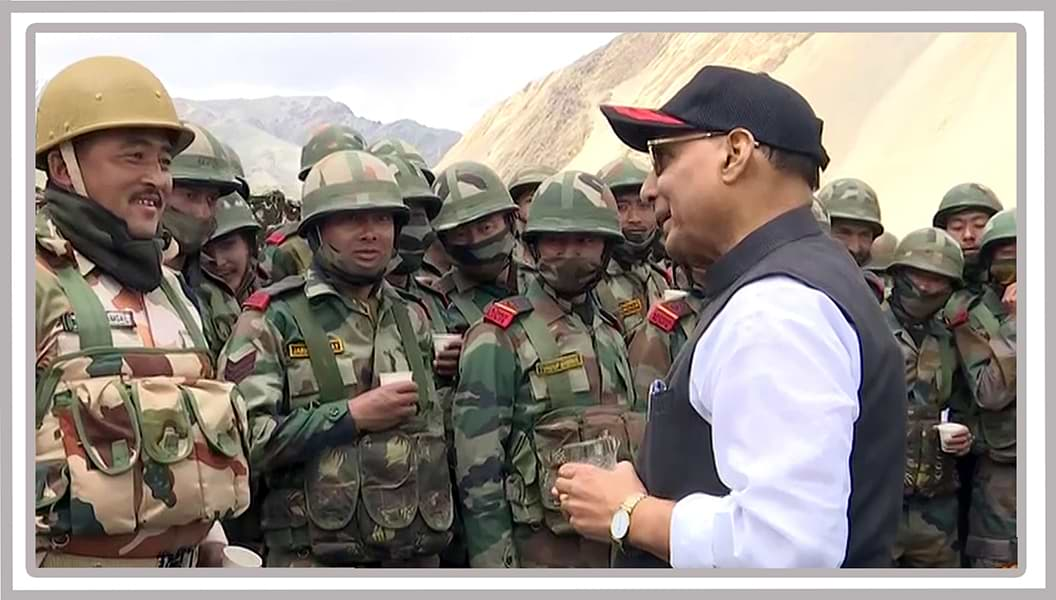
Since May 2020, there has been tension between the Security forces of India and China over the border region of Ladakh. This situation saw tension increase as China put pressure on India. Singh met with officials of the Indian Army and also visited the Ladakh Range. He also met with the Chief of the Defence Staff General Bipin Rawat, CNS Admiral Karambir Singh and COAS General Manoj Mukund Naravane to discuss the situation.
After the martyrdom of 20 Indian soldiers during the 2020 China–India skirmishes in Galwan Valley, Singh met with the Indian soldiers. He also said that he can’t guarantee to what extent the tension would go. Later the situation was handled.